Kembali ke Artikel

The USD index is still elevated, but it has made a technical downside breakout that increases the odds it declines further.
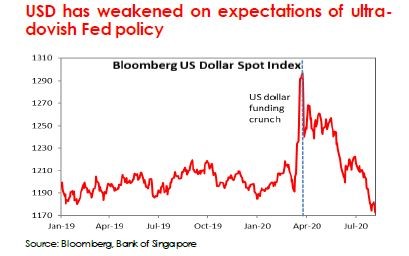
Falling US real yields and rising risk assets is a significant challenge for the USD. Disappointing US jobless claims and consumer confidence warn of some US growth moderation due to a virus pick-up. The macro outlook for the US has become muddier but not muddied enough to undermine risky assets.
Renewed Covid-19 outbreaks restrict economic activity but also heighten expectations that the Fed will keep accommodation ample and Congress will deliver timely fiscal stimulus. Fed facility extensions should keep financial conditions supportive. It seems easier to agree on US monetary than fiscal policy. Congress needs to agree fresh fiscal stimulus before its 10 August recess as USD1.5trn of earlier emergency aid is expiring now.
The USD should stay under pressure, as the Fed remains fearful about the economy and thus is likely to ease monetary conditions at its next meeting in September. We expect the Fed to shift to ‘average inflation targeting’, which means the central bank may not start raising interest rates from their current levels near zero for up to the next five years. This would keep the USD in a downtrend -- to the benefit of risk assets.
A lower USD index is not just about the falling USD, but it is also a story of the rising EUR. The European Union deal was a historic achievement for Europe. The EURUSD broke out of its almost two-year range of 1.06-1.15 and is set to trend stronger to 1.25 in 12 months’ time (old forecast: 1.17). The new European Union Recovery Fund significantly strengthens Europe’s economic outlook by providing for greater fiscal transfers. For the first time since the EUR’s inception in 1999, the EU will have significant resources to counter economic shocks. The ‘break-up’ risk of the EUR has diminished and in turn this is leading European peripheral bonds spreads narrower to bunds.
The fund’s bonds will be attractive safe-haven assets for investors seeking to diversify out of USD. EUR’s role could increase and make a dent in USD’s dominant role in global reserve assets.
We lower our 12-month USDCNY target to 6.75 (old: 6.80), with the extent of spill-over from a weaker USD outlook limited by rising tensions between the US and China -- a trend that should continue as the US presidential election enters a more intense phase. Although US-China tensions are heating up, as long as tariffs are not raised nor material financial sanctions imposed (say on China/Hong Kong SAR banks), then the impact on CNY will likely remain temporary rather than sustained. Trump will likely be cautious in pursuing anti-China policies such as tariff war that are harmful to US economic interests and could adversely impact financial markets so close to the November presidential elections.
Democrat nominee Biden’s lead in US election polls and prediction markets appears to be widening. Higher odds of Biden becoming President could mean still firm but a less disruptive approach in dealing with China but the implications for CNY seem underappreciated still. A pivot away from tariffs as a primary enforcement tool used by the current US administration would likely lead to a stronger CNY against the greenback.
Historically, CNY has moved notably on tariffs but less so on other types of escalations events. A Democratic presidency is likely also to adopt a more favourable view of international institutions and alliances.
This article was first published by Bank of Singapore on August 6, 2020. The Opinions expressed in this publication are those of the authors. They do not purport to reflect the opinions or views of Bank OCBC NISP Private Banking Tbk. or its affiliates.
OCBC NISP Private Banking provides a suite of products for wealth creation, preservation and transmission including holistic wealth management services, independent research, customized solutions for all investor preferences, and genuine open architecture, with expertise in Indonesia and Asia Pacific markets. OCBC NISP Private Banking is a part of OCBC Group.